Footpaths play a critical role in Melbourne’s urban infrastructure. They support pedestrian movement, improve accessibility, and contribute to public safety across residential streets, commercial zones, and transport corridors. Over time, councils, developers, and property owners face a common decision: should an existing footpath be repaired, or is full new construction the better option?
This post takes a technical and practical approach to comparing footpath repair and new construction in Melbourne. It explains engineering considerations, lifecycle costs, compliance requirements, and construction methods, while aligning with modern construction project management practises. The goal is to help decision-makers choose the most suitable approach based on site conditions, performance needs, and regulatory obligations.
Understanding Footpath Infrastructure in Melbourne
Footpaths in Melbourne are typically constructed using concrete slabs, segmental footpath pavers, asphalt, or a combination of materials depending on location and usage. These pedestrian pathways must comply with:
- Local council design standards
- Australian Standards (including AS 1428 for accessibility)
- Disability Discrimination Act (DDA) requirements
- Drainage and stormwater management guidelines
A qualified civil contractor Melbourne based will usually assess footpath condition, subgrade stability, pedestrian volume, and surrounding services before recommending repair or reconstruction.
What Is Footpath Repair?
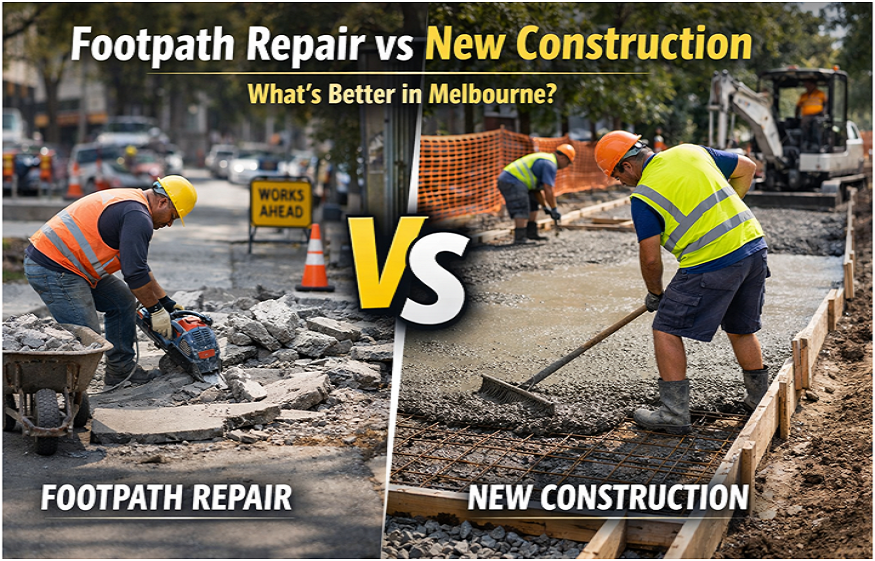
Footpath repair involves restoring an existing pavement without removing the entire structure. The intent is to extend service life, improve safety, and maintain compliance while minimising cost and disruption.
Common Footpath Repair Methods
- Crack sealing and joint repair
- Localised slab replacement
- Surface grinding to remove trip hazards
- Re-levelling sunken concrete panels
- Replacing damaged footpath pavers in Melbourne streetscapes
When Footpath Repair Is Suitable
Footpath repair is generally appropriate when:
- Structural damage is localised
- The base and subgrade remain stable
- Drainage issues are minor
- Compliance gaps can be rectified without redesign
From a construction project management perspective, repairs are often faster to deliver and easier to schedule around traffic and pedestrian flows.
Advantages of Footpath Repair
Cost-Effective Infrastructure Solution
Footpath repair is a cost-effective option when damage is limited to cracks, uneven slabs, or small surface defects. In many parts of Melbourne, footpaths are still structurally sound but show wear due to age, tree roots, or minor ground movement. Repairing these areas helps restore safety and usability without the high cost of full replacement. From a construction project management point of view, repair works allow councils and property owners to maintain multiple locations within a controlled budget.
Shorter Construction Time and Less Disruption
Repair works usually take much less time than full footpath construction. Since only damaged sections are fixed, work can often be completed quickly and pedestrian access can be restored sooner. This is important in busy areas where long closures can affect residents, shops, and daily movement. Shorter construction time also means fewer traffic controls and less inconvenience to the public.
Reduced Risk to Underground Services
Many footpaths in Melbourne are built over underground services such as water pipes, sewer lines, and electrical cables. Footpath repair involves limited excavation, which lowers the risk of damaging these services. For a civil contractor Melbourne based, this reduces safety risks, avoids unexpected delays, and helps keep project costs under control.
Longer Use of Existing Footpath Assets
Repairing footpaths helps extend the life of existing infrastructure. Fixing surface damage early prevents further deterioration and delays the need for full reconstruction. This approach supports better asset planning by keeping footpaths safe and functional for longer while meeting basic compliance requirements.
Limitations of Footpath Repair
Despite its benefits, footpath repair is not always the best solution.
Key Constraints
- Repaired sections may not match existing surface finishes
- Underlying subgrade failure cannot be fully addressed
- Repeated repairs can increase long-term costs
- Older designs may still fail accessibility standards
In high-traffic areas, repeated repairs can become inefficient and disruptive.
What Is New Footpath Construction?
New footpath construction involves complete removal and reconstruction of the pavement system, including excavation, base preparation, and surface installation. This approach is commonly used in urban upgrades, redevelopment projects, and heavily deteriorated pathways.
Typical Scope of New Footpath Construction
- Removal of existing pavement
- Subgrade assessment and stabilisation
- Installation of crushed rock base
- Drainage improvements
- Concrete placement or footpath pavers installation
- Compliance upgrades for kerb ramps and gradients
Professional footpath construction services follow detailed specifications to meet council and state requirements.
Advantages of New Footpath Construction
Stronger Structure and Better Long-Term Performance
New footpath construction is the best option when damage is widespread or the existing footpath has ongoing structural issues. By rebuilding the footpath from the ground up, engineers can improve the base layers and ensure proper support. This results in a stronger and more durable footpath that performs well in high-traffic areas and locations exposed to service vehicles.
Full Compliance with Current Standards
One of the main benefits of new footpath construction Melbourne projects is full compliance with current accessibility and safety standards. Older footpaths often do not meet modern requirements due to incorrect slopes or uneven surfaces. New construction allows accurate control of levels, gradients, and surface finishes, ensuring safe and accessible paths for all users.
Longer Lifespan and Lower Maintenance Over Time
A newly constructed footpath generally lasts much longer than a repaired one. When delivered by experienced footpath construction services, new footpaths can remain in good condition for decades with minimal maintenance. Although the initial cost is higher, the reduced need for future repairs often makes new construction more cost-effective in the long run.
Fixing the Root Causes of Damage
Repeated footpath damage is often caused by poor drainage, weak soil, or tree roots. New construction allows these issues to be identified and corrected during the build process. Improving drainage and soil stability helps prevent future failures, resulting in a more reliable and long-lasting footpath.
Better Visual and Streetscape Outcomes
New footpath construction offers more design flexibility and allows the use of modern materials such as footpath pavers in Melbourne. This helps footpaths blend better with surrounding streets, landscaping, and public spaces. In commercial and redevelopment areas, this improves pedestrian comfort and overall street appearance.
Limitations of New Construction
New construction also presents challenges that must be managed carefully.
Key Considerations
- Higher upfront capital cost
- Longer construction duration
- Increased disruption to pedestrians and traffic
- More complex approvals and stakeholder coordination
Effective construction project management is critical to control timelines, costs, and public impact.
Cost Comparison: Repair vs New Construction
| Aspect | Footpath Repair | New Construction |
|---|---|---|
| Initial Cost | Low to moderate | High |
| Construction time | Short | Longer |
| Disruption | Minimal | Moderate to high |
| Design flexibility | Limited | High |
| Asset lifespan | Short to medium | Long |
| Compliance upgrade | Partial | Full |
While repairs are cheaper initially, repeated interventions can exceed the cost of a single reconstruction over time.
Engineering Factors That Drive the Decision
A qualified civil contractor Melbourne professionals rely on technical assessments to guide decisions.
Key Assessment Criteria
- Pavement Condition Assessment
The first step in deciding between repair and new construction is checking the visible condition of the footpath. Engineers assess cracking, uneven slabs, surface wear, and the number of past repairs. If damage is limited and spread over small areas, repair may be suitable. However, widespread cracking or repeated failures often indicate deeper structural problems that cannot be fixed with surface repairs alone.
- Subgrade Strength and Moisture Conditions
The soil beneath the footpath plays a major role in its performance. Weak or moisture-affected subgrade can cause ongoing movement and settlement. If testing shows that the soil lacks strength or holds excess water, repairing the surface will not stop future damage. In such cases, rebuilding the footpath allows proper ground treatment and long-term stability.
- Impact of Tree Roots
Tree root growth is a common cause of footpath damage in many parts of Melbourne. Roots can lift slabs and create uneven walking surfaces. Minor root-related damage may be managed through repair, but ongoing root intrusion usually requires reconstruction along with root barriers to prevent repeated lifting and cracking.
- Drainage Performance
Poor drainage allows water to collect under the footpath, weakening the base and soil layers. This often leads to sinking slabs and surface cracking. If drainage issues are localised, they may be corrected during repair works. Where drainage problems are widespread or linked to poor design, with new construction, it’s easier to design better water flow and avoid problems down the line.
- Pedestrian Load and Usage Levels
Footpaths in busy areas experience higher stress due to heavy pedestrian use and occasional service vehicle loads. Older or weakened footpaths may not be designed for current demand. In these locations, repair may only provide a short-term solution, while new construction allows the pavement to be designed for present and future usage.
- Below-Surface Failures
When the main cause of footpath damage lies below the surface, repair alone is rarely effective. Surface fixes may temporarily improve safety, however, the root issue causing the failure is not corrected. New construction is often the most reliable option when structural issues originate beneath the pavement.
If failures originate below the surface, repair alone is rarely sufficient.
Role of Footpath Pavers in Melbourne Projects
Footpath pavers are increasingly used in Melbourne due to their modularity and visual appeal.
Benefits of Using Pavers
- Easy replacement of damaged units
- Strong aesthetic control in urban design
- Better integration with heritage precincts
- Reduced cracking compared to large slabs
However, pavers require:
- Precise base preparation
- Skilled installation
- Ongoing joint maintenance
They are more suitable for new construction or full surface replacement rather than small repairs.
Compliance and Risk Management
Both repair and reconstruction must address:
- Trip hazard thresholds
- Slip resistance
- Clear pedestrian width
- Accessibility requirements
Failure to meet standards can expose councils and property owners to liability claims. Engaging experienced footpath construction services helps manage technical and legal risks.
Choosing the Right Option in Melbourne
Footpath Repair Is Best When:
- Damage is isolated
- Budget constraints are tight
- Service life extension is the main goal
- Subgrade remains stable
New Construction Is Better When:
- Structural failure is widespread
- Accessibility upgrades are required
- Streetscape renewal is planned
- Long-term performance is the priority
Conclusion
In Melbourne, the choice between footpath repair and new construction is not a simple cost-based decision. It requires technical evaluation, lifecycle analysis, and compliance planning. Repairs offer a practical solution for localised damage, while new construction provides long-term performance, safety, and design flexibility.
Engaging a qualified civil contractor Melbourne specialists and experienced footpath construction services providers ensures that the selected approach meets engineering standards and delivers reliable outcomes. By aligning decisions with sound construction management principles, Melbourne’s footpaths can remain safe, accessible, and durable for decades to come.